
TendersGo AI for Cybersecurity Tenders in India

India's digital transformation continues at a rapid pace, bringing with it an escalating need for robust cybersecurity measures across both public and private sectors. For businesses specializing in cybersecurity — from audit and risk assessment to managed security services and advanced threat intelligence — identifying relevant tender opportunities within India's complex procurement ecosystem presents a unique challenge. These opportunities are often dispersed across various government portals, departmental websites, and industry-specific platforms, frequently published with diverse terminology and in multiple languages. Navigating this landscape effectively requires not just diligence, but sophisticated tools capable of sifting through vast amounts of data to pinpoint genuine prospects, especially when dealing with critical areas like cybersecurity tenders India.
The Cybersecurity Imperative in Indian Procurement
The Indian government, along with its various ministries, departments, and public sector undertakings (PSUs), is a significant procurer of cybersecurity solutions. This demand stems from a growing awareness of cyber threats, coupled with regulatory mandates and the sheer scale of digital operations. From securing critical infrastructure and citizen data to protecting defense systems, the scope of cybersecurity procurement is broad. Opportunities range from cyber security audits, vulnerability assessments, and penetration testing to the provision of Security Operations Center (SOC) services, implementation of firewalls and endpoint security, and incident response planning. Such tenders can appear on the Central Public Procurement Portal (CPPP), the official Government eProcurement System, or even specialized portals like the Defence procurement portal for Ministry of Defence projects.
The practical workflow for a bid manager or business development professional targeting this sector involves continuous monitoring of these diverse sources. They must track "tender," "e-tender," "bid," "corrigendum," "notice inviting tender," "request for proposal (RFP)," and "request for quotation (RFQ)" documents. Beyond these general procurement terms, specific cybersecurity keywords like "SIEM," "CDN/security services," "CERT-In empaneled auditor," and "cloud-network-security" are crucial for identifying relevant projects. The sheer volume and variety of these notices, often coupled with technical specifications and legal jargon, make manual discovery and initial qualification a time-consuming and error-prone process.
AI-Powered Discovery for Indian Cybersecurity Tenders
The challenge of finding specific cybersecurity tenders in India is precisely where AI-driven solutions demonstrate their value. TendersGo AI Assistant, supported by advanced GPT models, provides a comprehensive approach to this problem. It allows users to search across 220+ countries and 145 languages, effectively bridging the linguistic and geographical gaps inherent in global procurement. For the Indian context, this means the platform can ingest non-English opportunities and present them in both their original language and standardized English, ensuring no relevant tender is missed due to language barriers. The AI assistant can filter by precise keywords such as "cyber security audit," "vulnerability assessment," or "managed security services," alongside more general terms like "IT security" or "network protection." This granular control, combined with the ability to define searches by country (India), organization, and sector (Cybersecurity), streamlines the initial discovery phase significantly. Furthermore, TendersGo provides AI tender summaries, offering quick insights into the scope and requirements of each opportunity without needing to download and parse full documents immediately. This intelligent filtering and summarization capability transforms the arduous task of tender monitoring into a strategic, efficient process.
Navigating Classification Codes and Local Terminology
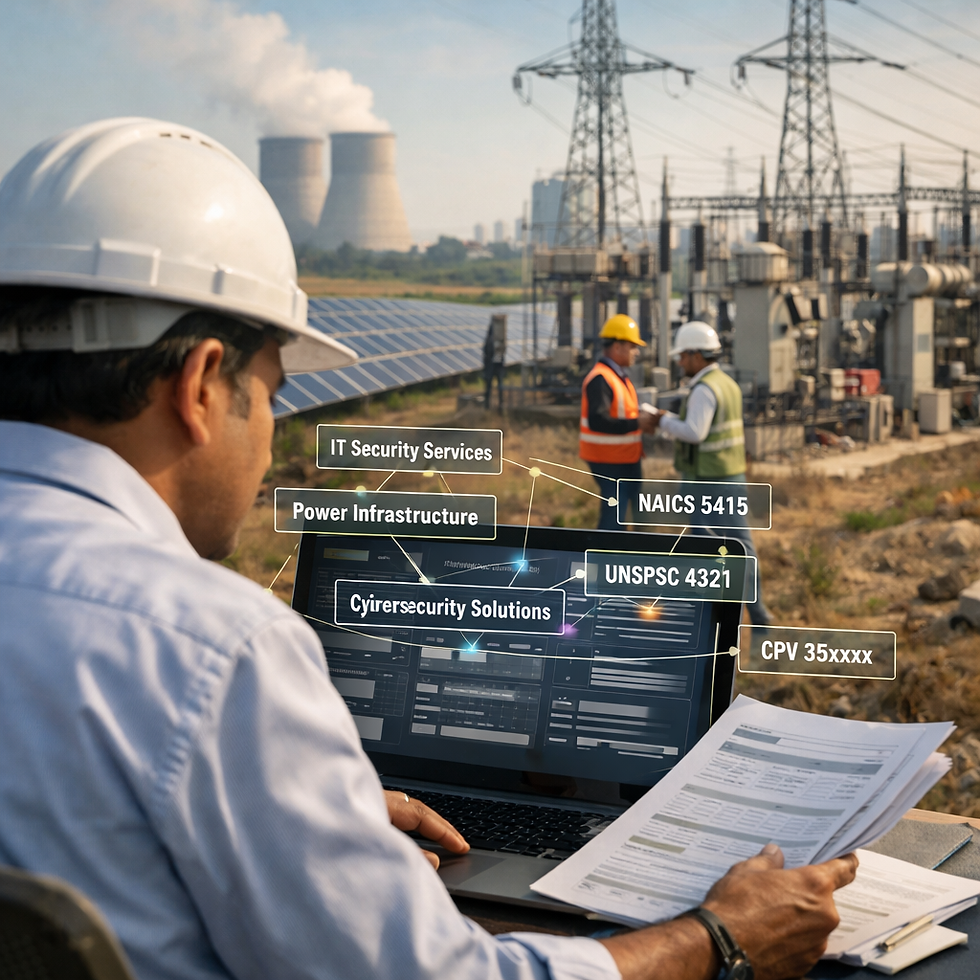
While international classification systems like CPV, NAICS, and UNSPSC are valuable for cross-border searches, Indian procurement portals often utilize their own internal categorization alongside or instead of these global standards. A search for "cybersecurity tenders India" might yield results categorized under "Information Technology Services," "Consulting Services," or even specific hardware procurement, depending on the portal's taxonomy. This necessitates a flexible search strategy that can combine keyword-based queries with classification codes where available. For instance, a bid manager might look for CPV codes related to "IT security services" (e.g., 72317000-4) or "computer security services" (e.g., 72212220-4), but simultaneously use keywords like "penetration testing" or "incident response" to capture opportunities that might be classified broadly but are highly specific in their requirements. The AI's ability to cross-reference keywords with classification systems, even when only implicitly present in the tender text, is crucial for comprehensive coverage.
Practical Search Scenarios for Cybersecurity Professionals
Consider a cybersecurity firm specializing in government compliance and audits. Their bid manager would typically be looking for opportunities mandating CERT-In empaneled auditors. On a platform like TendersGo, they could set up a search using keywords such as "CERT-In," "cyber security audit," and "compliance." They would then specify "India" as the country. The AI would then identify tenders across various Indian government portals, including the CPPP, that contain these terms. For a company offering managed security services, the search might involve keywords like "managed security services," "SOC," "SIEM," and "incident response," combined with filters for "services" under the procurement type. This allows for a highly targeted approach, moving beyond generic IT tenders to focus specifically on cybersecurity-related projects.
Another scenario involves a vendor of cybersecurity software, such as endpoint detection and response (EDR) or firewall solutions. Their search would combine product-specific keywords (e.g., "EDR," "firewall," "DLP") with terms like "supply," "implementation," and "support." They might also filter by "supplies" as a procurement type. The AI's capability to process both structured data (like classification codes) and unstructured text (tender descriptions and attachments) ensures that even nuanced requirements embedded within tender documents are not overlooked. This multi-faceted search approach is essential given that cybersecurity procurement can span works, supplies, and services, often within a single tender.
AI for Enhanced Monitoring and Lifecycle Tracking
Beyond initial discovery, the lifecycle of a tender in India, particularly on platforms like CPPP, includes corrigenda (amendments), clarifications, and ultimately, award details. Tracking these changes manually for numerous tenders is impractical. A key advantage of AI-powered tender monitoring is its ability to track these updates automatically. When a department uploads corrigenda or clarification documents, the AI can detect these changes and alert the user. This is critical for bid managers who need to stay informed about modifications to deadlines, scope, or technical specifications that could impact their proposal. The CPPP's emphasis on departments uploading not just initial tender enquiries but also corrigenda and award details makes it an ideal environment for AI-driven lifecycle tracking. This ensures that a business is always working with the most current information, reducing the risk of submitting an non-compliant bid due to missed updates.
The Role of AI in Overcoming Language Barriers in Indian Procurement
While central portals often publish tenders in English, especially for high-value or global opportunities, local and state-level procurements, as well as supplementary documents, may frequently appear in regional Indian languages. This presents a significant hurdle for businesses that lack multilingual capabilities. Here, AI's linguistic prowess becomes indispensable. TendersGo AI can process and summarize tender documents and notices published in any of the 145 supported languages. This means that a tender originally published in, say, Marathi or Bengali on a state government portal can be immediately translated and summarized into English, providing the bid manager with the core information needed to assess its relevance. This capability is not just about translation; it's about making opportunities accessible that would otherwise remain hidden behind language barriers, thereby democratizing access to a wider range of cybersecurity procurement opportunities across India.
For cybersecurity firms looking to expand their footprint in India, accessing and understanding the full spectrum of tender opportunities is paramount. TendersGo provides a powerful solution for this, offering a sophisticated search engine covering 220+ countries and 145 languages. Its AI Assistant, with 77 sector-focused agents, is adept at sifting through the complexities of Indian public and private procurement. Users can leverage detailed search and filter dimensions including keywords, country (India), organization, sector (Cybersecurity), and classification codes like CPV, NAICS, and UNSPSC. The platform's ability to present non-English opportunities in both original language and standardized English, coupled with AI tender summaries, significantly reduces the effort required to identify and qualify prospects. Businesses can create saved searches and receive daily email alerts, ensuring they never miss a relevant cybersecurity tender in India, whether it's for an audit, a new security system, or ongoing managed services. Visit TendersGo.com today and set up your tailored alerts for cybersecurity tenders across India, leveraging cutting-edge AI to streamline your business development efforts.
Beyond Keywords: Semantic Search and Contextual Understanding
Traditional keyword searches can be limited when dealing with the nuanced language of procurement documents. A tender for "network security enhancement" might implicitly require "firewall upgrades" or "intrusion detection systems" without explicitly mentioning these terms. Advanced AI models, like those powering TendersGo, go beyond simple keyword matching to understand the semantic context of tender descriptions. This means the AI can infer related concepts and identify opportunities that might not perfectly match a user's exact search terms but are highly relevant. For cybersecurity, where technologies and threats evolve rapidly, this semantic understanding is crucial. It allows the AI to connect a broad requirement for "data protection" with specific solutions like "encryption services" or "data loss prevention (DLP) tools," ensuring a more comprehensive discovery of potential projects. This capability is particularly beneficial in a market like India, where tender specifications can vary widely in their level of detail and terminology.
Future-Proofing Tender Discovery with AI
As India's digital infrastructure continues to expand and cyber threats become more sophisticated, the demand for advanced cybersecurity solutions will only grow. The procurement landscape will likely become even more dynamic, with new technologies and regulatory requirements shaping tender specifications. AI-powered tender discovery platforms are uniquely positioned to adapt to these changes. By continuously learning from new tender data and evolving procurement language, AI can help cybersecurity firms stay ahead of the curve. It can identify emerging trends in cybersecurity procurement, flag new compliance requirements (e.g., related to data privacy laws), and even predict potential areas of government investment. For bid managers and business development professionals, this means not just finding current opportunities but also gaining strategic insights into the future direction of cybersecurity spending in India. This forward-looking capability, combined with efficient daily monitoring, transforms tender discovery from a reactive task into a proactive strategic advantage, ensuring businesses are always ready to respond to the most promising cybersecurity tenders in India.





