
AI RFP Search for Chile Water Utility Analytics

Chile's water utilities, like many globally, face increasing pressure to optimize operations, reduce water loss, and enhance service delivery in the face of climate change and urbanization. This imperative drives a growing demand for advanced analytics, particularly in areas like leak detection and network management. For international technology providers, navigating the Chilean public procurement landscape, centered on Mercado Público, presents both opportunity and complexity. The challenge lies not just in identifying relevant tenders, but in doing so efficiently, overcoming language barriers, and accurately interpreting procurement nuances within a system that may not explicitly label opportunities as "RFPs" in the Western sense. This is where the power of AI-driven search becomes indispensable, transforming a labor-intensive, often fragmented process into a strategic advantage for identifying water utility analytics procurement opportunities.
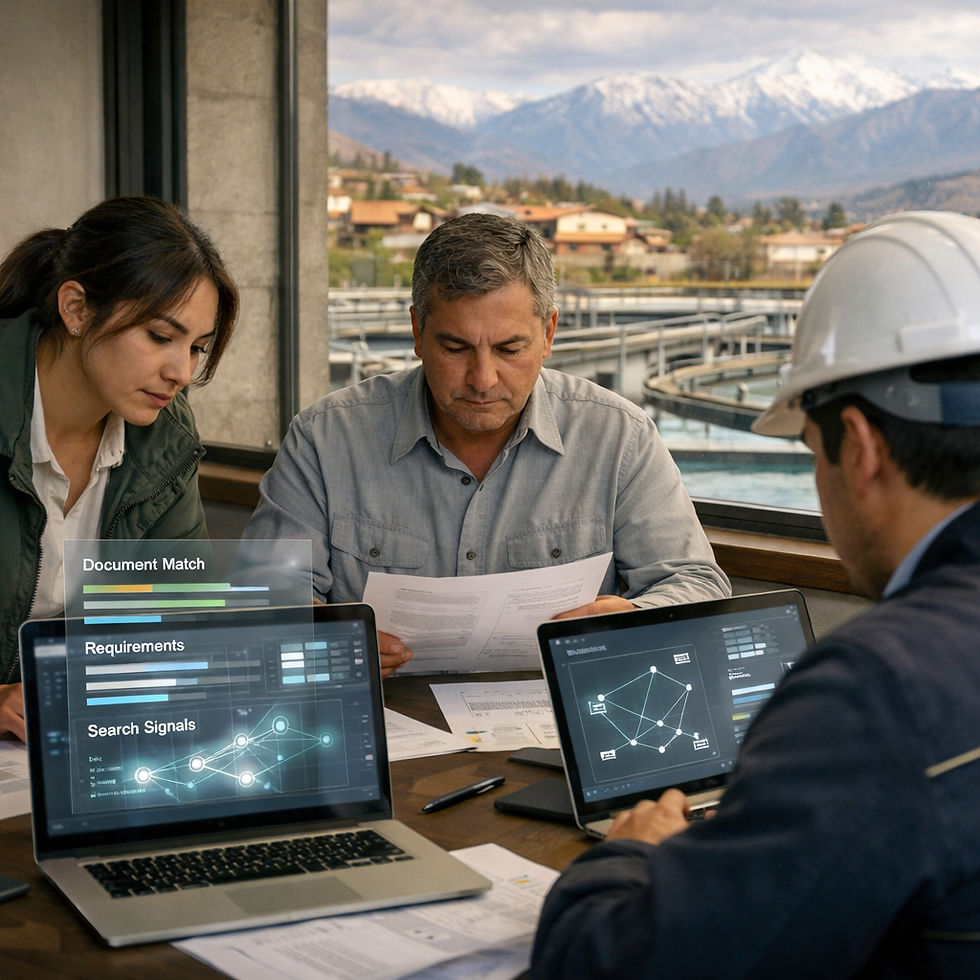
The Chilean Water Sector's Digital Imperative and Procurement Landscape
Chile's water sector is a dynamic environment, with a strong focus on public utility operations and infrastructure development. The legal framework, primarily Law 19.886, mandates electronic procurement through ChileCompra's Mercado Público platform for all public purchasing. This centralized system means that opportunities for providing digital transformation services, including AI analytics and leak detection solutions for water management, are published on this single portal. For a bid manager or a business development professional targeting this market, understanding that "RFP" might translate to various forms of "licitación" (tender) within Mercado Público is crucial. These tenders can cover everything from consultoría (consultancy) to servicios (services) or even suministros (supplies) for software solutions, making a direct keyword match challenging without intelligent search capabilities.
Mercado Público: The Gateway to Chilean Public Water Procurement
Mercado Público, operated by ChileCompra, is the mandatory transactional platform for over 850 public agencies in Chile. This includes municipalities, public works entities, and various public bodies with water-related responsibilities. For companies offering solutions in areas like telemetría (telemetry), analítica (analytics), and detección de fugas (leak detection) for agua potable (drinking water) and alcantarillado (sewerage), Mercado Público is the primary source of opportunities. However, the sheer volume of tenders, coupled with the Spanish-only content and the variety of ways water-related requirements are classified, presents a significant hurdle for non-Spanish speaking or internationally focused teams. The procurement process, from the issuance of bases (bidding documents) to contract awards, unfolds within this digital ecosystem, necessitating a robust approach to discovery and monitoring.
The Workflow Challenge: From Broad Search to Targeted Opportunity
Imagine a bid manager in a global technology firm tasked with identifying opportunities for AI-driven leak detection software in Chile. Their initial search might involve broad terms like "Chile water utility RFP" or "leak detection software tender." However, these English terms are unlikely to yield direct results on Mercado Público. The manager would then need to translate these concepts into Spanish, using terms like "licitación detección de fugas agua" or "software analítica empresa sanitaria." This manual translation and keyword guessing is inefficient and prone to missing relevant opportunities due to linguistic variations or sector-specific jargon. Furthermore, Chilean tenders often classify digital solutions under broader categories like "servicios de consultoría" or "transformación digital" rather than a specific "software" designation. The real procurement problem is filtering through thousands of daily opportunities on a foreign-language platform to pinpoint the few highly relevant ones that align with their AI-driven solutions for water utilities.
This is precisely where the TendersGo AI Assistant proves invaluable. Equipped with GPT models and supported by 77 sector-focused AI agents, it can intelligently process and translate complex search queries from English into nuanced Spanish terminology relevant to Chilean public procurement. A bid manager can input "AI analytics for water utility leak detection in Chile," and the TendersGo AI Assistant will not only translate this into relevant Spanish keywords like "analítica predictiva fugas agua potable" or "software detección temprana fugas sanitarias" but also understand the underlying intent. It then searches across TendersGo's database of 220+ countries and 145 languages, including all tenders from Mercado Público, presenting non-English opportunities in both their original Spanish and a standardized English version, complete with AI tender summaries to quickly grasp the core requirements.
The Nuances of "RFP" in the Chilean Context: Beyond Terminology
While the term "RFP" (Request for Proposal) is common in many procurement systems, Chile's Mercado Público operates with its own specific terminology and processes. Tenders are typically referred to as "licitaciones," and the documents outlining requirements are "bases de licitación." These "bases" serve the same function as an RFP, detailing technical specifications, evaluation criteria, and contractual terms. For a company offering AI analytics for water utilities, understanding that their "RFP search" is effectively a search for "licitaciones" related to analítica de datos para empresas sanitarias or soluciones de gestión inteligente del agua is fundamental. The challenge extends beyond mere translation; it involves grasping the procedural and terminological differences that define public procurement in Chile. An AI-powered search tool can bridge this gap by mapping common international procurement concepts to their Chilean equivalents, ensuring no relevant opportunity is missed due to a linguistic or semantic mismatch.
Practical Application: AI-Powered Search for Smart Water Opportunities
Consider a practical scenario. A company specializing in AI-driven predictive maintenance for water infrastructure wants to find Chilean public tenders. Instead of manually sifting through Mercado Público, they could use an AI-assisted platform. The search intent is clear: find opportunities for "smart water" solutions, specifically those involving AI for operational efficiency and leak detection. The AI system would then translate and expand this intent into a comprehensive search strategy, incorporating terms like "transformación digital sector agua," "optimización redes hidráulicas," "inteligencia artificial para gestión de recursos hídricos," and "monitoreo de infraestructura de agua."
The search would then be filtered by country (Chile) and sector (Water/Utilities). Further refinement could involve specifying "Services" or "Consultancy" as procurement types, as digital solutions often fall under these categories rather than "Supplies" for physical goods. The AI could also identify relevant CPV, NAICS, or UNSPSC codes associated with water management, software, and IT services, even if the original tender doesn't explicitly use them, by inferring from the textual description. For instance, a tender for "servicios de consultoría para el desarrollo de un sistema de información geográfica (SIG) para la gestión de redes de alcantarillado" might implicitly involve AI analytics capabilities, which an intelligent AI search could flag, even if "AI" isn't explicitly mentioned.
Identifying Key Buyers and Monitoring the Opportunity Space
Beyond individual tender discovery, AI can assist in identifying potential buyer types and monitoring their procurement activity. For water utility analytics, likely buyers include state-owned water companies (empresas sanitarias), municipalities, and the Ministry of Public Works (MOP). An AI system could track procurement patterns from these entities on Mercado Público, noting their preferred procurement types, common requirements, and even potential partners. This allows a proactive approach to business development, moving beyond reactive tender responses to strategic market engagement.
For example, if the Ministry of Public Works consistently issues tenders related to "infraestructura hídrica" that include clauses for "digitalización y modernización," an AI tool could highlight these as potential future avenues for AI analytics solutions. The system could also monitor for market consultations or requests for information (RFIs), which often precede formal tenders, providing an early warning system for upcoming opportunities related to utility digital transformation . This kind of ongoing intelligence, facilitated by AI, shifts the focus from merely finding a tender to understanding the evolving procurement landscape of key Chilean water sector players.
The Power of AI in Classifying and Summarizing Complex Tenders
Chilean tender documents, or "bases de licitación," can be extensive and highly technical, written exclusively in Spanish. Manually reviewing these documents for every potentially relevant opportunity is time-consuming and requires specialized language skills. An AI-powered system can significantly streamline this process. Once a relevant tender is identified, the AI can provide an immediate summary, highlighting key requirements, deadlines, budget (if specified), and evaluation criteria. This allows bid managers to quickly assess the suitability of an opportunity without having to read through dozens or hundreds of pages of Spanish text.
Furthermore, AI can assist in classifying tenders. While Mercado Público provides some classification, the AI can perform a deeper semantic analysis. For instance, a tender classified broadly as "Servicios" might, upon AI analysis, be re-classified as "AI Analytics for Predictive Maintenance" or "IoT Solutions for Water Quality Monitoring." This granular classification helps in building a more accurate pipeline of opportunities and ensures that highly specific solutions, such as those for smart water sourcing , are not overlooked due to generic official classifications. The ability to cross-reference with CPV, NAICS, and UNSPSC codes further enhances this classification, providing a standardized way to understand the nature of the procurement even when local classifications vary.
For international companies seeking to penetrate the Chilean public water sector, a platform like TendersGo.ai offers a significant competitive edge. With its global tender and contract search engine covering over 220 countries and 145 languages, TendersGo is uniquely positioned to address the complexities of cross-border procurement. By leveraging its powerful search capabilities, users can filter opportunities by keywords, country (Chile), sector (Water), and even specific classification codes like CPV or NAICS. The TendersGo AI Assistant, supported by GPT models and specialized AI agents for various sectors, excels at understanding the intent behind complex search queries, translating them into relevant Spanish terms for Mercado Público, and presenting non-English opportunities in standardized English with concise AI-generated summaries. This functionality dramatically reduces the time and effort required to identify relevant "RFP-style" tenders for water utility analytics and leak detection, providing a clear pathway through the Chilean procurement system.
Beyond Discovery: Monitoring and Strategic Positioning
The procurement cycle doesn't end with discovery. Continuous monitoring is essential for staying ahead in a competitive market. Premium features on platforms like TendersGo.ai support saved searches and daily email alerts. This means that once a bid manager has configured a precise search for "Chile water utility RFP" or "AI analytics procurement" opportunities specific to the Chilean water sector, they can receive automated notifications whenever a new, relevant tender is published on Mercado Público. This proactive monitoring ensures that companies are among the first to know about emerging opportunities, allowing ample time for proposal preparation and strategic decision-making.
Moreover, AI can help in understanding market trends within Chilean water procurement. By analyzing historical tender data, AI algorithms can identify recurring needs, preferred technologies, and even potential partner organizations. This intelligence can inform product development, market entry strategies, and local partnership efforts. For instance, if there's a trend towards tenders requiring integrated IoT solutions for water quality monitoring alongside AI for leak detection, a company can tailor its offerings to meet this evolving demand, positioning itself strategically within the Chilean market for smart water sourcing and utility digital transformation .
Navigating the Future of Chilean Water Procurement with AI
The Chilean public procurement landscape, with its centralized Mercado Público system and Spanish-language content, presents a unique set of challenges for international providers of AI analytics and leak detection solutions for water utilities. However, these challenges are increasingly surmountable with the strategic application of AI-powered search and monitoring tools. By leveraging AI to overcome language barriers, decipher complex procurement terminology, and intelligently classify opportunities, businesses can move beyond manual, time-consuming searches to a more efficient and strategic approach to market engagement. The future of identifying and securing public contracts in the Chilean water sector lies in embracing these AI technologies, transforming what was once a daunting task into a streamlined, intelligence-driven process. For anyone looking to find Chilean public water tenders for analytics, leak detection, telemetry, and utility digitalization, start your targeted search on TendersGo.ai today to tap into the full spectrum of opportunities available on Mercado Público and beyond.





