Philippines Cloud Services: Multilingual AI Procurement with TendersGo AI

The Philippines’ digital transformation journey is accelerating, and with it, the demand for cloud services across government agencies. This creates a dynamic, albeit complex, landscape for businesses looking to engage with public sector procurement. While English often serves as the official language for national tender documents, the nuances of local phrasing, combined with a mixed procurement environment spanning competitive tenders, RFQs, and eMarketplace catalogs, present significant challenges for identifying relevant opportunities. This is where multilingual AI procurement in the Philippines becomes not just an advantage, but a necessity, particularly for cloud services providers.
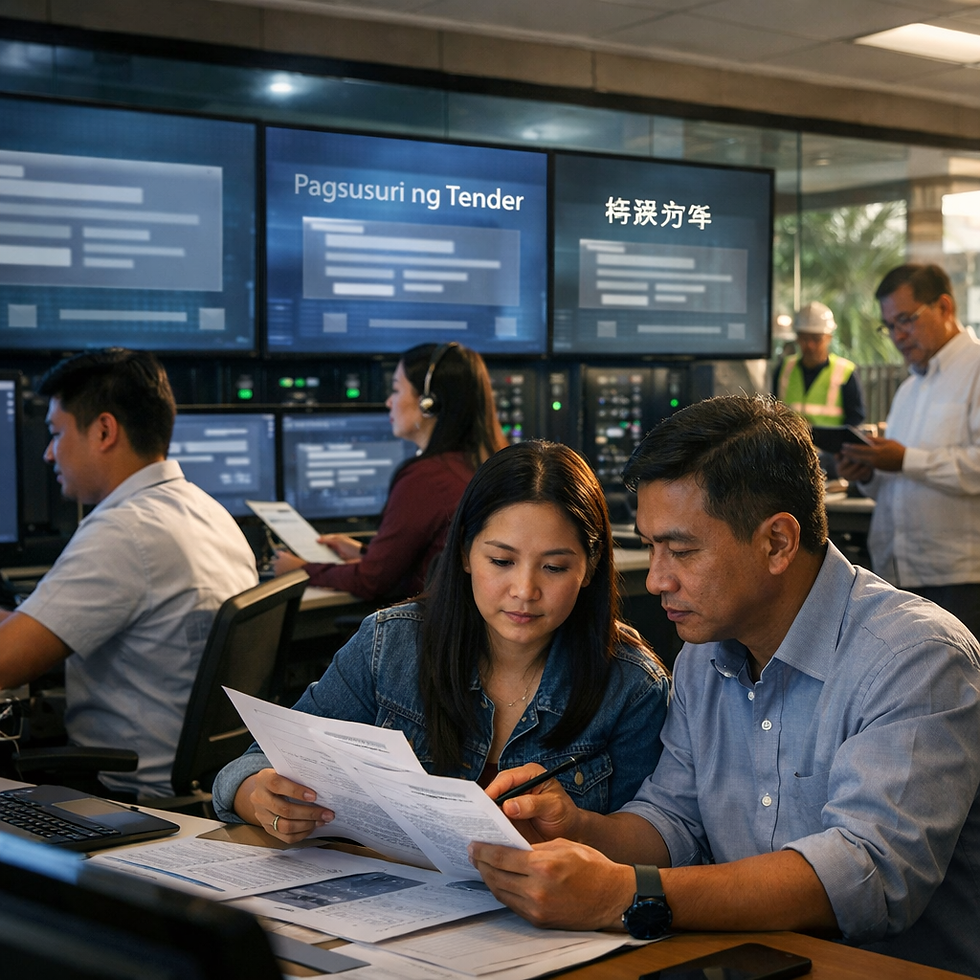
The core of public procurement in the Philippines revolves around the Philippine Government Electronic Procurement System (PhilGEPS), designated as the single electronic portal under the new procurement regime. However, identifying cloud services opportunities isn't as straightforward as a single keyword search. Agencies procure cloud computing platforms, hosting, communication tools, and software through various channels. For instance, the PS-DBM eMarketplace, originally for common-use supplies and equipment (CSE), has expanded to include cloud/software items, exemplified by the onboarding of Google Cloud Computing Services in June 2026. Simultaneously, agencies like the Cooperative Development Authority (CDA) continue to post bids and RFQs for cloud computing service subscriptions and cloud hosting. This mixed approach, combined with terms like "bidding," "RFQ," "Purchase Order," and "contract renewal," necessitates a sophisticated search strategy that traditional methods often cannot provide.
For procurement and bid managers, the real problem isn't a lack of opportunities, but rather the difficulty in discovering and classifying them effectively. A search intent might be as specific as "cloud hosting RFQ Philippines" or as broad as "PhilGEPS cloud services." However, the results can be fragmented across different sections of PhilGEPS, the PS-DBM eMarketplace, or even agency-specific announcements. Furthermore, while English is prevalent, understanding the local context and potential for nuanced language in agency notices can be crucial. This is precisely where the TendersGo AI Assistant, supported by advanced GPT models and its 77 sector-focused AI agents, proves invaluable. It can process and standardize non-English opportunities, presenting them in a uniform English format while retaining the original language for verification. This capability is particularly powerful for navigating a mixed procurement environment like the Philippines, where the description of cloud services might vary significantly across different posting types and agencies, allowing users to efficiently filter by keywords, country, organization, and even specific CPV or NAICS codes, ensuring no relevant opportunity is missed, whether it's a competitive tender or a catalog listing.
Navigating the Philippine Cloud Services Procurement Ecosystem
The Philippine procurement landscape for cloud services is shaped by recent legislative changes and evolving digital infrastructure. The implementation of RA No. 12009 (New Government Procurement Act) in August 2024, and its subsequent Implementing Rules and Regulations (IRR), has set the current framework. This new legal structure emphasizes efficiency and transparency, pushing more procurement activities onto digital platforms like PhilGEPS. For cloud services, this means a dual approach: some services are procured through traditional bidding processes, while others are available via the PS-DBM eMarketplace, which now functions as a catalog for common-use items, including software and cloud solutions.
Understanding this duality is critical. A company offering cloud-based communication tools, for instance, might find opportunities listed as a "contract renewal" on a specific agency's page, or as a competitive "RFQ" for a new subscription. Simultaneously, the same company might be able to offer its services directly through the PS-DBM eMarketplace if its products are onboarded, as seen with Google Cloud offerings. This mixed model demands a flexible and comprehensive search strategy that can span various procurement types and official portals, moving beyond simply searching for "RFP" and embracing terms like "bidding," "Purchase Order," and "small value procurement."
The Role of PhilGEPS and the PS-DBM eMarketplace
PhilGEPS remains the central repository for government procurement information, serving as the primary channel for public procurement under RA 12009. All major tenders, RFQs, and notices of award are typically published here. For a bid manager targeting cloud services, a regular check of PhilGEPS is non-negotiable. However, the PS-DBM eMarketplace adds another layer of complexity and opportunity. Its expansion to include cloud/software items, such as Google Cloud offerings, signifies a move towards streamlined acquisition for certain digital services. This means a cloud provider might not always be looking for a large-scale competitive tender but could instead find consistent demand through catalog sales.
Consider a scenario where a company provides cloud storage solutions. They would need to monitor PhilGEPS for larger, custom cloud infrastructure projects from agencies like the Department of Information and Communications Technology (DICT). Concurrently, they would also need to track the PS-DBM eMarketplace for smaller, recurring orders for cloud storage subscriptions that fit the CSE category. The challenge lies in efficiently monitoring both channels, especially when specific service descriptions might not align perfectly with generic classification codes. For instance, a "cloud hosting service for its website" (as seen with the CDA) might be described differently than a generic "cloud computing platform," requiring a more nuanced search approach than simple keyword matching.
Multilingual AI for Enhanced Discovery of Cloud Opportunities
While English is the primary language for formal procurement documents in the Philippines, agency-specific notices or local government unit (LGU) postings might incorporate local phrasing or colloquialisms. This is particularly true in a mixed procurement environment where descriptions might vary in detail and language depending on whether it's a formal tender document or a brief notice for a small value procurement. For cloud services, where technical specifications can be dense, the ability to process and understand these linguistic variations is crucial. Multilingual AI procurement tools address this by ensuring that no opportunity is overlooked due to language barriers or subtle differences in terminology.
Imagine a scenario where an LGU posts an RFQ for "serbisyo ng ulap para sa komunikasyon" (cloud service for communication). A traditional English-only search might miss this. However, with multilingual AI capabilities, this phrase can be accurately translated and matched with relevant English keywords like "cloud-based communication tools" or "cloud telephony services." This capability extends beyond direct translation; it involves understanding the intent and context behind the phrasing, allowing for a more comprehensive discovery of opportunities. This is particularly valuable when dealing with sector-specific jargon or when searching for services described by their function rather than a generic cloud category.
Practical Examples: Searching for Cloud Services
Let's consider how a bid manager might use AI-assisted search to find cloud service tenders in the Philippines. Instead of just searching for "cloud computing," they could employ a multi-faceted strategy:
Keyword Combinations: Search for "PhilGEPS cloud services" alongside "cloud hosting RFQ Philippines" or "cloud computing subscription Philippines." This ensures coverage of both the central portal and specific procurement types.
Agency-Specific Monitoring: Set up alerts for specific agencies known to be digitally active, such as the Cooperative Development Authority (CDA) or the Government Procurement Policy Board–TSO, and combine this with cloud-related keywords. For example, "CDA cloud hosting" or "GPPB cloud-based video communication."
Procurement Type Filters: Filter results by "RFQ," "bidding," or "contract renewal" to distinguish between new projects and ongoing service needs. This is especially useful for understanding recurring demand, as evidenced by the GPPB–TSO's 2026 renewals for cloud-based video communication applications.
eMarketplace Integration: While TendersGo is a search engine and not the contracting authority, understanding that items like "Google Cloud eMarketplace Philippines" are being procured through PS-DBM's eMarketplace informs search strategy. A bid manager might search for terms related to these specific offerings to identify complementary services or upcoming renewals if the base product is already in use.
The challenge with cloud services often lies in their dynamic and evolving nature. A single CPV code might not fully capture the breadth of "cloud computing platforms" or "cloud-based communication tools." Therefore, a robust search strategy combines structured classification codes with flexible keyword searches and an understanding of the local procurement terminology. The ability of AI to process these varied inputs and provide coherent results is a significant advantage.
AI for Classification and Monitoring in a Mixed Environment
The classification of cloud services in public procurement notices can be inconsistent. Unlike tangible goods, cloud services are often described by their function, brand, or the specific problem they solve, rather than a single, universally applied public code. While CPV, NAICS, or UNSPSC codes exist, tender documents in the Philippines might emphasize documentary requirements and portal usage more than a precise, standardized cloud-services taxonomy. This makes AI-driven classification and monitoring particularly valuable.
An AI system can learn to identify patterns in how cloud services are described across different types of procurement postings – from formal bidding documents on PhilGEPS to brief RFQs from LGUs. For instance, it can recognize that "cloud-based communication applications" from a GPPB-TSO renewal notice, "one-year cloud computing service subscription" from the CDA, and even mentions of specific products like "Gemini Enterprise" in PS-DBM announcements, all relate to the broader cloud services sector. This intelligent classification allows bid managers to track the entire opportunity space for cloud services, regardless of how precisely the opportunity is worded or classified by the contracting authority.
Monitoring Recurring Demand and Policy Shifts
Beyond initial discovery, AI also plays a crucial role in continuous monitoring. The Philippine government’s procurement of cloud services is not a one-off event; it involves recurring demand, renewals, and responses to policy shifts. For example, the GPPB's continued issuance of resolutions and guidance under RA 12009 means the procurement environment is constantly evolving. An AI-powered monitoring system can track these policy updates and cross-reference them with active tenders, providing bid managers with an early warning system for changes that might impact their proposals.
For cloud services, understanding the cycle of "contract renewal" is key. Many cloud subscriptions are annual or multi-year, leading to predictable renewal cycles. While a basic search might identify a renewal notice, AI can help in understanding the context – who the incumbent provider is (if mentioned), the scope of the service, and potential opportunities for competitive bids or expanded services. This proactive monitoring allows companies to engage with agencies well before a renewal deadline, positioning themselves effectively for future opportunities. By establishing saved searches and daily email alerts, TendersGo users can continuously monitor for new cloud services opportunities, whether they are competitive tenders, RFQs, or catalog updates. This proactive approach ensures that businesses are always informed about the latest developments in the Philippine cloud services procurement landscape, from new project announcements on PhilGEPS to specific product onboarding on the PS-DBM eMarketplace, all presented in a standardized, easy-to-digest format.
Future-Proofing Cloud Service Procurement in the Philippines
The trajectory of cloud services procurement in the Philippines points towards increased digitalization and a more sophisticated approach to sourcing. As more government agencies migrate their operations to the cloud, the volume and complexity of related procurement opportunities will only grow. This will further necessitate advanced tools for discovery, classification, and analysis.
The ongoing refinement of procurement rules under RA 12009 and the expansion of platforms like the PS-DBM eMarketplace signal a commitment to modernizing government operations. For cloud service providers, this means staying agile and leveraging technology to keep pace. The ability to quickly identify new requirements, understand subtle policy changes, and respond effectively will be paramount. This is not just about finding tenders; it's about understanding the evolving needs of the Philippine public sector and positioning one's offerings strategically.
The future of procurement in the Philippines for cloud services will likely see an even greater reliance on digital platforms and potentially more standardized ways of describing cloud solutions. However, the initial phase, as demonstrated by 2026 activities, will continue to be a mix of traditional and catalog-based procurement, with varying terminologies. Therefore, tools that can bridge these gaps, offering multilingual capabilities and intelligent classification, will be indispensable for businesses aiming to secure a significant share of the Philippine cloud services market. Engaging with these opportunities effectively requires more than just a presence on PhilGEPS; it demands an intelligent, AI-driven approach to market intelligence and bid management.