AI Tender Search for India’s semiconductor equipment sourcing gap

India's ambitious drive to establish itself as a global semiconductor manufacturing hub is creating a dynamic, yet complex, landscape for equipment and materials suppliers. With the India Semiconductor Mission (ISM) now firmly in its second phase, dubbed Semicon 2.0, the focus has shifted significantly towards building domestic capabilities in manufacturing equipment and critical materials. This policy pivot, backed by a substantial outlay of ₹1,27,500 crore, translates into a surge of public procurement opportunities. However, for international and domestic suppliers, identifying these opportunities is far from straightforward. The procurement landscape is fragmented, with tenders for everything from highly specialized cleanroom equipment to essential gases and chemicals often appearing under broader industrial or electronics categories across various government portals. This is where AI-driven tender search becomes not just advantageous, but essential for businesses aiming to tap into India’s burgeoning semiconductor ecosystem.

The Evolving Landscape of India's Semiconductor Procurement
The journey of India's semiconductor ambitions officially began in January 2022 with the launch of the India Semiconductor Mission. Fast forward to July 2026, and the approval of Semicon 2.0 marks a critical inflection point, as highlighted by official government announcements. This phase explicitly prioritizes the development and sourcing of semiconductor manufacturing equipment and materials within India, alongside strengthening global supply chains. The committed investment of ₹1.64 lakh crore across 12 approved semiconductor manufacturing projects, with at least three already in commercial production, signals a robust and expanding demand pipeline. This isn't merely about "chips" anymore; it encompasses the entire ecosystem: fabs, display fabs, advanced packaging (ATMP/OSAT), design, and the intricate web of machines, materials, utilities, and services required to bring these facilities online and keep them operational.
From Policy to Procurement: Identifying Fragmented Opportunities
For procurement and bid managers, the challenge lies in translating these high-level policy directives and investment figures into actionable tender opportunities. Unlike a single, monolithic "semiconductor tender," the reality on the ground is a mosaic of specific requirements. A typical semiconductor manufacturing facility, or fab, requires an immense array of specialized equipment and services. This includes wafer fabrication tools, metrology and inspection systems, advanced packaging machinery, ultra-pure water systems, HVAC and cleanroom infrastructure, specialty gases, process chemicals, and a host of IT and automation solutions. Each of these components, services, or materials may be procured through individual tenders or e-tenders, often published by different authorities – central government, state governments, or public sector undertakings (PSUs) – on platforms like the Central Public Procurement Portal (CPPP) or the GeM ecosystem.
The complexity is further compounded by the classification systems used on these portals. While some tenders might explicitly mention "semiconductor," many critical components will be listed under more generic codes such as "electrical machinery," "industrial equipment," "laboratory apparatus," "chemical products," or "construction services." This fragmentation makes traditional keyword-based searches inefficient, often leading to missed opportunities or an overwhelming volume of irrelevant results.
AI's Role in Bridging India's Semiconductor Sourcing Gap
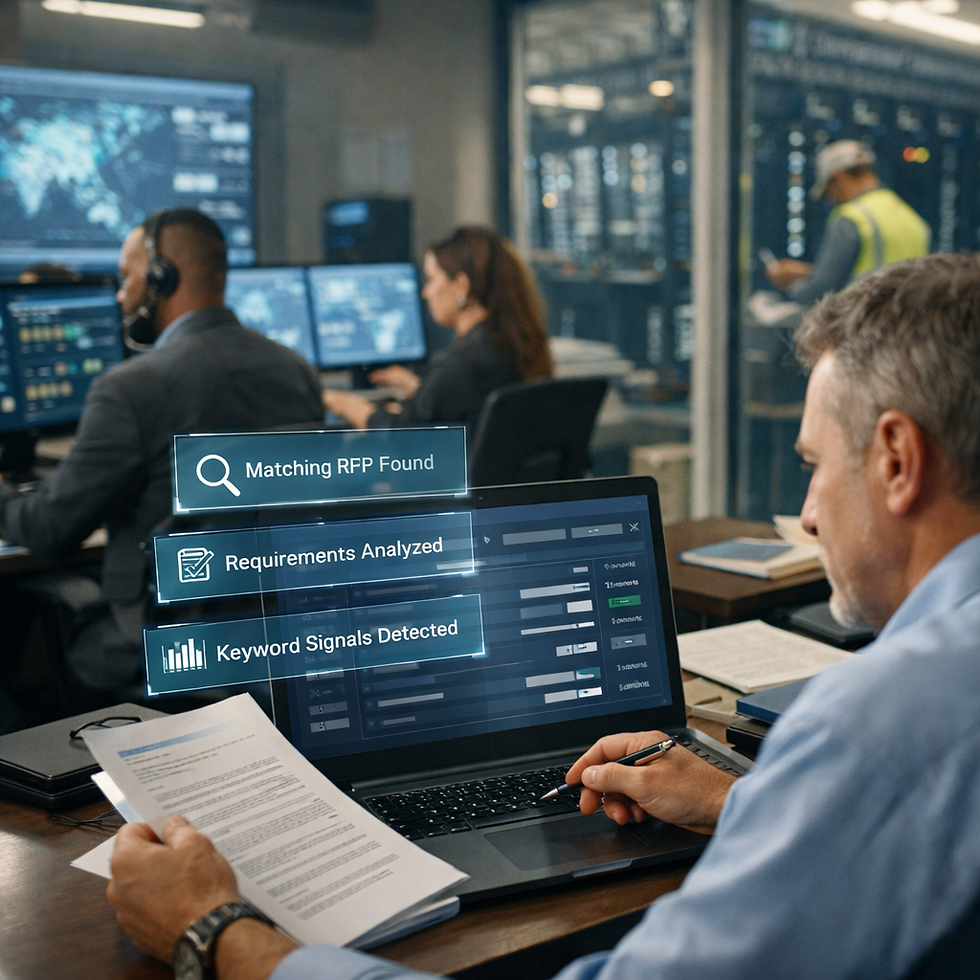
The sheer volume and fragmented nature of public procurement in India, especially for a complex sector like semiconductors, creates a significant discovery challenge. Manually sifting through thousands of daily tender announcements across multiple portals, often in different languages, is time-consuming and prone to human error. This is precisely where AI-powered tender search engines demonstrate their transformative potential. Instead of relying solely on exact keyword matches, AI can understand the nuanced context of procurement requests, identify related terms, and even infer intent from less explicit descriptions.
For instance, an AI assistant can be trained to recognize that a tender for "ultra-pure water generation system" or "HVAC for controlled environments" is highly relevant to semiconductor manufacturing, even if the word "semiconductor" isn't explicitly stated. This contextual understanding, supported by advanced natural language processing (NLP), allows businesses to cast a wider yet more precise net for opportunities. TendersGo AI Assistant, supported by sophisticated GPT models, provides 77 sector-focused AI agents, which can be invaluable here. A bid manager looking for opportunities in India's semiconductor sector could leverage these agents to monitor for tenders related to "cleanroom equipment," "wafer processing tools," or "specialty gases," automatically identifying relevant opportunities that might otherwise be overlooked due to generic classification or non-standard terminology. This significantly reduces the manual effort involved in opportunity discovery and ensures a more comprehensive coverage of the market.
Practical AI-Assisted Search Strategies for Semiconductor Tenders
To effectively identify semiconductor-related procurement opportunities in India, a multi-faceted AI-assisted search strategy is crucial. This goes beyond simple keyword searches and leverages the power of AI to understand the underlying requirements. Here are practical examples of how a bid or procurement professional could approach this:
Targeted Keyword Combinations with Contextual AI: Instead of just "semiconductor equipment," use combinations like "fab equipment India," "ATMP plant tender," "cleanroom construction Mumbai," or "metrology tools Bangalore." An AI system can then analyze the tender document's full text, not just the title, to determine relevance. For example, a tender mentioning "process gases for electronics manufacturing" or "chemical delivery systems for high-purity applications" would be flagged as relevant, even if "semiconductor" is absent.
Classification Code Expansion: While India’s official portals use CPV, NAICS, or UNSPSC codes, these are often broad. An AI system can learn which broader codes frequently contain semiconductor-relevant tenders. For instance, tenders classified under "Industrial Machinery and Equipment" (e.g., UNSPSC 23000000) or "Laboratory, Measuring, Observing and Testing Equipment" (e.g., UNSPSC 41110000) might contain specific requirements for wafer inspection or lithography tools. The AI can then prioritize tenders within these categories that exhibit other semiconductor-related linguistic cues.
Geographic and Organizational Filtering: Given that approved projects are spread across various states, filtering by country (India) and specific regions or cities (e.g., Gujarat, Uttar Pradesh, Telangana, Karnataka) is vital. Additionally, monitoring tenders from specific organizations known to be involved in semiconductor projects or related PSUs can yield direct results.
Language Agnostic Search: With government communications often in both English and Hindi, an AI system capable of processing both languages is invaluable. A search for "semiconductor equipment" in English should also capture tenders using Hindi terms like "सेमीकंडक्टर उपकरण" (semiconductor upakaran) or related industrial terminology, presenting them in a standardized English format for easy review.
Monitoring for Ecosystem Development: The "machines and materials" focus of Semicon 2.0 means tenders will not just be for core fab equipment but also for supporting infrastructure. This includes tenders for power infrastructure, water treatment plants, waste management services, and even specialized logistics for hazardous materials. AI can identify these adjacent opportunities by linking them to the broader semiconductor project context.
Navigating India's Public Procurement Ecosystem with AI
India’s public procurement landscape is extensive, with the Central Public Procurement Portal (CPPP) serving as the primary hub for Government of India e-tenders. Alongside CPPP, the GeM (Government e-Marketplace) ecosystem and various state-level and PSU-specific portals also host a significant number of opportunities. For semiconductor equipment and services, tenders are likely to appear on CPPP, especially for large central government-backed projects or those from PSUs involved in research and development or infrastructure. State-level portals will be crucial for projects initiated by state governments or local authorities supporting the semiconductor ecosystem, such as establishing industrial parks or providing utilities.
The official sources, such as the India Semiconductor Mission website and Press Information Bureau releases, consistently highlight the need for domestic capability in equipment and materials. This policy signal is a strong indicator for suppliers to actively monitor tenders that might include "Make in India" clauses or preferences for local manufacturing and servicing. NITI Aayog's call for a national demand aggregation platform further underscores the procurement-driven nature of this sector's growth. While such a platform is in development, AI tender search tools offer an immediate solution for aggregating these fragmented demands.
The "Machines and Materials" Focus: What to Look For
The shift towards "machines and materials" in ISM 2.0 means that bid managers should broaden their search parameters beyond just "semiconductor manufacturing." The government's emphasis on fortifying domestic and global supply chains means opportunities exist across a wide spectrum. This includes:
Core Manufacturing Equipment: Tenders for lithography, etching, deposition, ion implantation, and chemical mechanical planarization (CMP) tools for fabs.
Assembly, Testing, Marking, and Packaging (ATMP/OSAT) Equipment: Opportunities for wire bonding, die attach, encapsulation, and final test equipment.
Metrology and Inspection Systems: Tenders for defect detection, critical dimension measurement, and in-line process control tools.
Cleanroom Infrastructure: Procurement for HEPA/ULPA filters, cleanroom garments, specialized flooring, and air handling units.
Utilities and Facilities: Tenders for ultra-pure water systems, industrial gas generation and delivery systems (e.g., nitrogen, oxygen, argon, specialty gases), wastewater treatment, and high-purity chemical supply.
Raw Materials and Consumables: Sourcing for silicon wafers, photoresists, process chemicals, sputtering targets, and other consumables.
IT and Automation: Opportunities for Manufacturing Execution Systems (MES), Statistical Process Control (SPC) software, and factory automation hardware.
Services: Tenders for equipment installation, maintenance, calibration, and specialized training.
Monitoring for these specific items, rather than just generic "semiconductor," will yield more targeted and actionable results. AI's ability to understand technical specifications and industry jargon can be particularly effective in identifying these niche requirements within broader tender documents.
Staying Ahead with AI-Powered Monitoring and Alerts
The pace of development in India's semiconductor sector is rapid, with new projects and tenders emerging constantly. For any business, staying updated is critical. Manually checking multiple portals daily is not feasible. This is where AI-powered monitoring and alert systems become indispensable. Once an effective search strategy is established, the next step is to automate the discovery process.
Businesses can set up specific search parameters covering keywords, classification codes, geographical regions, and even organizations of interest. TendersGo provides a robust solution for this, allowing users to save their intricate search queries. These saved searches can then be configured to deliver daily email alerts directly to the bid management team. This ensures that as soon as a relevant tender, RFP, or RFQ is published across any of the 220+ countries and in any of the 145 languages TendersGo covers, the team is immediately notified. For India's semiconductor sector, this means a bid manager will receive timely alerts for new opportunities related to "semiconductor equipment," "fab construction," or "specialty chemicals for electronics," regardless of whether the original tender was published in English or Hindi, and standardized into English summaries for quick review. This proactive approach ensures no critical opportunity is missed due to the fragmented nature of the procurement landscape or language barriers, providing a significant competitive advantage in a fast-evolving market.
The Road Ahead: Consolidating Demand and Expanding Reach
As India continues to solidify its position in the global semiconductor supply chain, the procurement landscape will likely evolve. The call from NITI Aayog for a national demand aggregation platform suggests a future where procurement might become more centralized for certain categories. However, until such mechanisms are fully mature, the current reality remains one of distributed opportunities across various central, state, and PSU portals.
For international suppliers looking to enter or expand within the Indian market, and for domestic players aiming to grow with the mission, the ability to efficiently discover and analyze these opportunities is paramount. The focus on domestic capability in equipment and materials under ISM 2.0 opens doors for both direct manufacturing and partnerships. Monitoring tender activity around SEMICON India events and related ecosystem development announcements, such as those concerning utilities, cleanrooms, and specialty materials, will provide further cues on upcoming procurement needs. AI-driven tender search tools offer the most effective means to navigate this complex but opportunity-rich environment, transforming a daunting search into a strategic competitive advantage. By leveraging these tools, businesses can proactively identify, analyze, and respond to the tenders that will shape India’s semiconductor future.